

Before 1st of August, Trump announced how much he would burden his trading partners with tariffs. These include tariffs of 10%, 15% and 30%. In fact, it is difficult to find a logical explanation for why certain countries received lower or higher tariffs, and many see economic warfare or political pressure behind the different rates. Just when everyone thought that this chapter was over and there was nothing more to see, it turned out that these rates could be adjusted up or down at any time. India has an average tariff of 25% simply because it uses Russian oil. So far, everything has been about India’s prime minister being a friend of Trump. But then there is Canada, which received a 35% tariff because it allegedly did not cooperate in preventing the flow of fentanyl. It seems that Brazil received 50% because Bolsonaro’s coup was defeated by the current ruling forces, so political pressure may be behind it. Switzerland received a 39% tariff because it has a trade surplus with the US, which Trump interprets as a loss for the US. As if that weren’t enough, the president pointed out that these tariffs are not set in stone and further increases are possible.
In my opinion, we have reached a point where it is no longer the actual level of customs duties that is of interest, but rather the uncertainty caused by the fact that conditions can be changed at any time, to any extent and for any reason. Under such circumstances, economic actors are unable to plan for the future.
And if they cannot plan for the future, they will halt investments, refrain from development, and wait it out, because in an uncertain situation, they do not know what the next step might be.
Inflation, unemployment
When the tariffs were first announced in April, on Liberation Day, the market was shocked and reacted with a huge drop. However, when the bond market also showed unfavorable signs and the yield on 30-year bonds rose above 5%, Trump backed down and postponed the introduction of tariffs for 90 days. The market calmed down and rebounded within a few weeks, even reaching new highs. The view spread that Trump was just bluffing and would back down at the last minute (Trump Always Chicken Out). However, on August 1, the tariffs were introduced, Trump did not back down, and the markets did not start to fall.
The Fed seems unyielding: it is convinced that tariffs will sooner or later cause inflation, as importers will pass on a significant portion of the tariff increase to consumers, and is therefore unwilling to cut interest rates. Trump responded by attacking the Fed chairman, calling him “too slow” and launching a personal attack against him. This caused a two-day decline, but then the stock market indices started to rise again. It seemed that nothing could stop the rise in prices…
Then August 1 arrived, when the employment statistics were released, and in my opinion, this could easily have been a game changer. The number of people employed increased by only 73,000 instead of the expected 104,000, and in fact, the previous two figures were also significantly revised downward. The May figure was revised to +19, and the June figure to +14… The labor force participation rate began to decline again, reaching the level it had shown during Covid, with an unemployment rate of 5.7%.
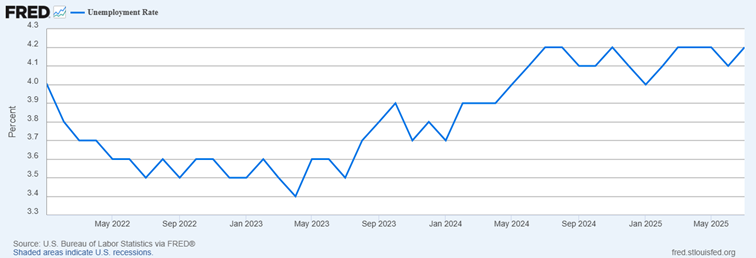
I am convinced that, of inflation and unemployment, customs duty increases have a greater impact on unemployment:
Customs duty increases lead to price rises, as importers pass on some or all of the duties to consumers. Consumer prices rise, but this immediately results in a certain degree of decline in demand. People do not buy as many products at higher prices, and inventories accumulate. This curbs inflation through price reductions on unsold products. At the same time, the expansion of new production capacity slows down, surplus labor is laid off, unemployment rises, and GDP declines due to the decline in consumption. Thus, tariffs result in a small increase in inflation, but a much larger increase in unemployment. July’s GDP figure was 3%, but only thanks to advance purchases. As prices rise and consumption volumes begin to decline, the US economy could even slide into recession.
This is what the Fed needs to consider, even though they are not in an easy position. They will hold an interest rate decision meeting on September 16-17, and I do not rule out the possibility of a surprise 50 basis point rate cut. If that happens, the stock markets and precious metals will skyrocket, but that rise will be the last. This is because interest rate policy works well when we are at the beginning or middle of the economic cycle. However, interest rate cuts only stimulate the economy, they do not control it. Interest rate cuts are useless if consumption declines, companies downsize, and masses of people end up on the street.
Real estate market
On 1st of August, when the employment data was released, it painted a particularly gloomy picture of the future. Bond markets immediately began to price in a September interest rate cut, with the proportion of those expecting an interest rate cut jumping from 45% to over 75%. As a result, yields on short-term bonds fell, with the yield on 2-year bonds falling by 6.88%, but yields on long-term bonds fell less, with the yield on 30-year bonds falling by only 2.4%. This is an interesting phenomenon because it has steepened the yield curve, meaning that market participants expect higher interest rates (higher inflation) in the future. Combined with the deterioration of the labor market, this could be a dangerous cocktail.
The Fed should lower interest rates to stimulate the economy and reduce unemployment, but this would contribute to inflation, not to mention the impact of customs tariffs…
Since mortgage interest rates are linked to long-term bond yields, if these remain high, interest rate cuts will only reduce short-term interest rates, and monthly mortgage payments will not decrease significantly. And if the number of unemployed people increases, people will find it difficult to pay the high mortgage interest rates. Therefore, I expect that a clear sign of recession will come when the number of delinquent borrowers in the mortgage market increases significantly. This means that the average consumer is suffering, their job is at risk, and they are struggling to pay their mortgage. And if properties have to be sold off, a significant drop in property prices is also conceivable. We saw the same pattern at the end of 2007…
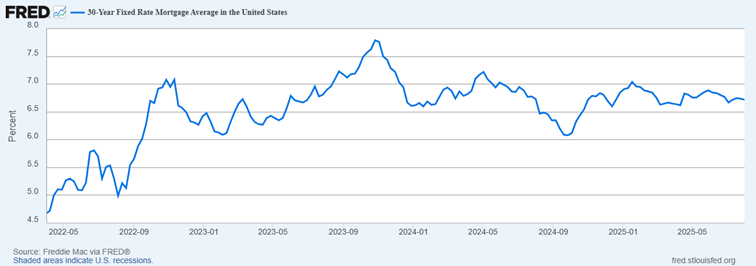
What happens with customs duties is an important factor, but I increasingly see that the imposition of customs duties was the flashpoint for the whole process. It is quite possible that the introduction and continuous increase of customs duties, as well as the threat of customs duties, will cause the economy, which is at the end of its cycle, to start a downward spiral. It will be worth keeping a close eye on how the situation develops in the coming months…